
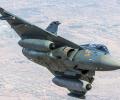
Flown by Group Captain A P Singh, the aircraft covered an altitude upto 11 km and supersonic speed of Mach 1.1, DRDO said in its release.
India's first light combat aircraft is the effort of 40 laboratories, 25 academic institutions and 300 companies.
In a last-minute twist, General Electric of the US has bagged the hotly contested $800-million tender to supply 99 engines for India's Tejas light combat aircraft (LCA). After both engines in the contest -- GE's F-414 and Eurojet's EJ-200 -- were found technically suitable, the F-414 has been declared the cheaper option.

Officially named Tejas, the aircraft has undergone over 1,000 hours of test flights.
India's indigenous Light Combat Aircraft is on schedule and would be comparable to frontline Mig-29 and Mirage 2000 fighters when it starts rolling out by 2011, Defence Minister A K Antony said in New Delhi on Thursday.
An important milestone for the naval programme of Bangalore-based Aeronautical Development Agency, the aircraft was brought out of the hanger where it was assembled part-by-part during the rollout.
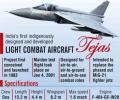
Thirty-two years after the project was sanctioned, the first indigenously-built Tejas Light Combat Aircraft was on Saturday handed over by Defence Minister Manohar Parrikar to the Indian Air Force, a red letter day for Indian defence and aerospace sector.

Indian Air Chief Marshal Amar Preet Singh and Japan Air Self-Defence Force (JASDF) Chief of Staff General Takehiro Morita took off from Air Force Station Jodhpur in Tejas aircraft on Sunday during the ongoing Indo-Japan bilateral air exercise 'Veer Guardian-2026'.
'The close collaboration between Pakistan and China, and the assistance Pakistan receives, is a factor in our planning, and the IAF is building its capacity to counter precisely such collusive threats.'

Air Chief Marshal AP Singh has voiced concerns over significant delays in inducting new combat jets, including the Tejas aircraft, which are impacting the Indian Air Force's depleting fighter squadron strength. He stressed the need for annual induction of 36-40 jets to address the gaps and discussed ongoing procurement plans like the MRFA deal and future strategies for combat aircraft and theatre commands.

Air Chief Marshal Ashutosh Dixit, India's new Chief of Air Staff, has outlined his top priorities, focusing on restoring the IAF's fighter squadron strength, accelerating indigenous programmes like Tejas and AMCA, and enhancing tri-services synergy. His vision, encapsulated by the acronym VAYU (Vigilance, Aatmanirbharta, Yukti, Unity), emphasises self-reliance in defence, tactical innovation, and integrated operations with the Army and Navy, alongside a commitment to air warrior welfare and national security.

Air Chief Marshal Ashutosh Dixit has taken over as the new Chief of Air Staff, succeeding Air Chief Marshal A P Singh. An accomplished fighter pilot with extensive experience, Dixit brings a distinguished career spanning four decades to his new role, having held various command and staff appointments.

The 5.8-tonne twin-engine gunship chopper is armed with air-to-air missiles, 20 mm turret guns, rocket systems and other weapons.

HAL has handed over a new batch of indigenous aircraft, marking another step in India's domestic aerospace manufacturing programme. The company delivered two LCA Tejas FOC twin-seater trainers to the IAF, completing twin-seater deliveries under the FOC contract.

Air Chief Marshal AP Singh, Chief of Air Staff, has expressed significant concern over the inordinate delays in inducting new combat jets, including the indigenous Tejas aircraft, stating that these delays are severely impacting the Indian Air Force's depleting fighter squadron strength. He highlighted the need for 36-40 new fighter jets annually to address these gaps and voiced worry over Pakistan's collaboration with China on a fifth-generation fighter jet.

The Indian Air Force (IAF) is establishing a maintenance facility for GE Aerospace's F404-IN20 jet engines, which power the Tejas light combat aircraft, with technical support from GE Aerospace. This initiative aims to enhance India's indigenous defence capabilities and reduce reliance on overseas repair centres.

Navy said the landing demonstrated India's capability to design, develop, construct and operate indigenous aircraft carrier with indigenous fighter aircraft.

President Droupadi Murmu will fly in the indigenously developed Light Combat Helicopter (LCH) 'Prachand' at the Jaisalmer Air Force Station. She will also attend the IAF's mega firepower demonstration 'Vayu Shakti' at the Pokhran Field Firing Range.
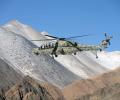
The defence ministry said 10 helicopters will be for the Indian Air Force and five will be for the Indian Army.

It will be inducted into the IAF inventory at a ceremony in Jodhpur in presence of Defence Minister Rajnath Singh and chief of air staff Air Chief Marshal VR Chaudhari.

The political confidence required to place high-end Japanese aircraft and personnel on Indian soil is itself a data point.
It indicates a level of trust that would have been difficult to imagine when India-Japan defence ties were largely symbolic, explains Varun Arya.

The Indian Air Force's Tejas light combat jets are scheduled to return to the skies next week after being grounded for two months due to a software glitch. HAL expects to deliver over 20 Tejas Mark 1A variants by December, but delays persist due to engine supply issues.

The Indian Air Force conducted a large-scale multinational Humanitarian Assistance and Disaster Relief (HADR) exercise, 'Sahayata Setu 2026', in Jamnagar, Gujarat. The drill showcased India's growing air power and disaster-response capabilities, involving various Indian agencies and representatives from 24 friendly foreign countries. Chief of Defence Staff General N S Raja Subramani highlighted India's commitment to human security and its role as a first responder in the Indian Ocean Region.
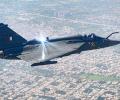
'The aircraft is expected to be ready for rollout between January and March 2026, and to fly by the end of the year.'
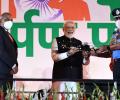
Prime Minister Narendra Modi on Friday handed over to the armed forces indigenously-developed light combat helicopters, unmanned aerial vehicles and electronic warfare systems for the warships, in reflection of India's focus to boost its domestic defence industry.

Built as an expendable, short-duration turbojet engine for single-mission applications, it can power tactical cruise missiles, anti-ship missiles, and long-range loitering munitions.

India has accumulated experience organically and in public, through blood, sweat and toil -- one commissioning and one agreement at a time -- and is called a regional power. China has accumulated hulls, by misdirecting its industrial capacity, and is mistakenly called a superpower. The Indo-Japan defence agreement pushes this theory to its limits without ever naming the dragon in the room, points out Dr Abhishek Puri.

Defence Minister Rajnath Singh has approved the "execution model" for the indigenous development of a fifth-generation deep penetration advanced medium combat aircraft (AMCA) for the Indian Air Force. The Aeronautical Development Agency (ADA) will execute the programme through industry partnership, with equal opportunities for both private and public sectors. The project is a major step towards "Aatmanirbharta" (self-reliance) in the aerospace sector and is expected to cost around Rs 15,000 crore.
In its annual report to Congress on Tuesday on 'Military and Security Developments Involving the People's Republic of China 2025', the US Department of War said the People's Liberation Army (PLA) is actively considering and planning for additional military facilities.

The Defence Acquisition Council (DAC) has approved procurement of long range rockets, missiles, radar systems and military platforms worth Rs 79,000 crore to bolster the military's combat prowess.
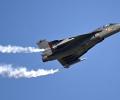
The delivery of the jets are facing delays primarily due to GE Aerospace missing several deadlines for supply of its aero engines to power the jets.
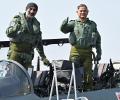
This was the first time two chiefs of the armed forces undertook a flight together.

The pilot ejected safely and a court of inquiry has been ordered to ascertain the cause of the accident, the IAF said in a brief statement.

India showcased its frontline military assets, including Brahmos and Akash missiles, at the Republic Day parade. The event also celebrated Operation Sindoor and featured a new 'Battle Array Format' for the Indian Army.
Despite a disappointing Q4 FY26 performance, many analysts remain bullish on Hindustan Aeronautics (HAL) due to its substantial order book and pipeline. However, persistent supply chain issues, particularly for jet engines, and execution challenges are key factors that could impact its future stock performance and revenue growth.

On February 27, President Droupadi Murmu undertook a sortie in the indigenous Light Combat Helicopter PRACHAND at Air Force Station Jaisalmer, Rajasthan.
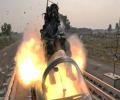
The DRDO conducted the test in collaboration with the Aeronautical Development Agency and Hindustan Aeronautics Limited.

India's indigenous fighter jet programme reached a key milestone on Friday, October 17, 2025, as the Tejas Mk1A made its maiden flight at Hindustan Aeronautics Limited's Nashik facility.

The defence ministry said 98 per cent of the total procurement worth Rs 2.23 lakh crore will be sourced from the domestic industries.
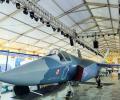
Private and public defence players can bid to participate in the stealth fighter development programme independently, as a joint venture, or as consortia.
